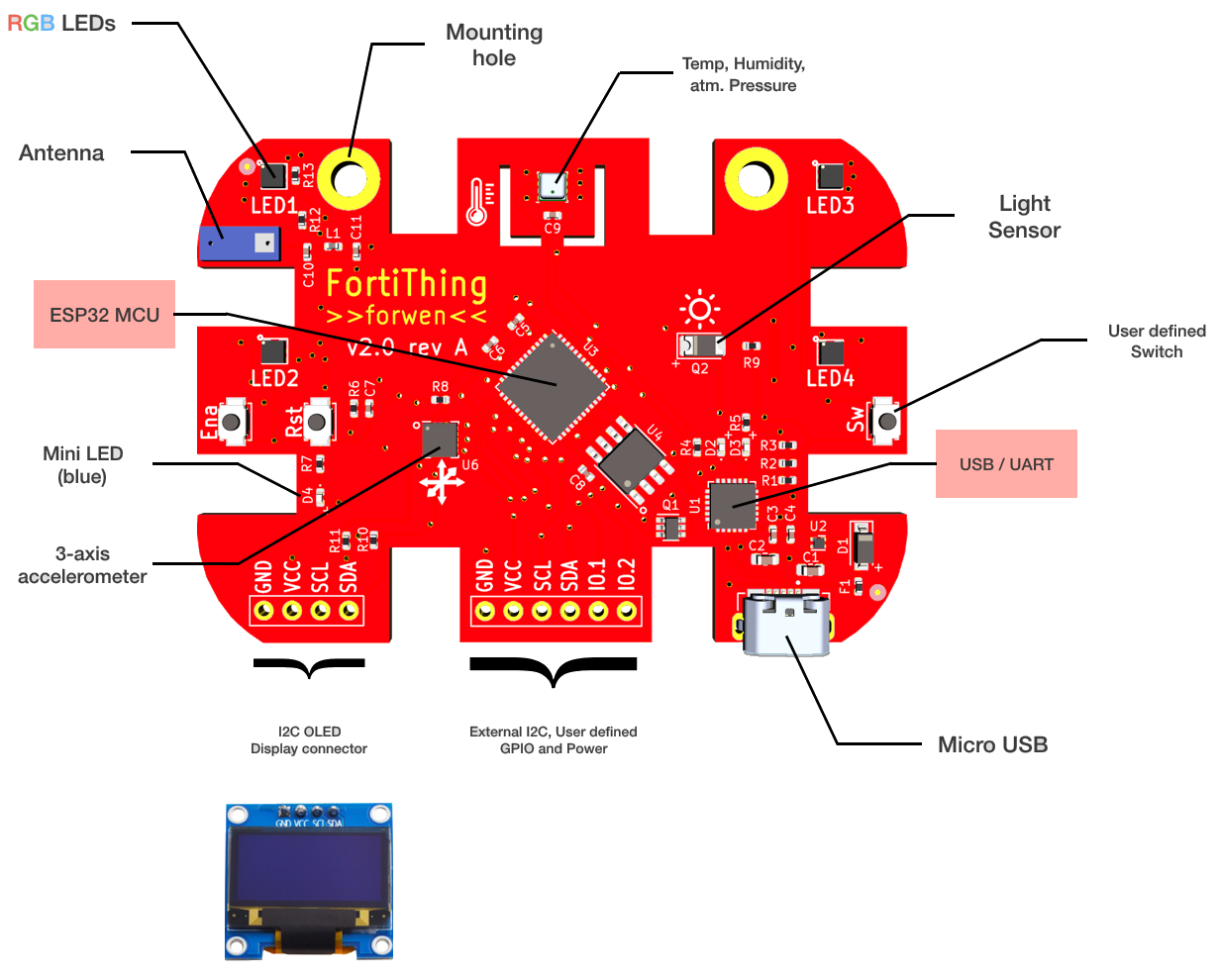
FortiThing Hardware Reference
Fortified PCB Layout
65mm x 45mm
Hardware Design in Detail
- Espressif ESP32 Pico D4 SIP
ESP32 SoC
4MB integrated Flash
internal oscillator
RF Module
7mm x7mm QFN
Dual-Core Tensilica Xtensa LX6 32bit Microprocessor
802.11 b/g/n Wireless
Bluetooth v4.2 (BR/EDR and BT LE support)
- Interfaces:
UART, SPI, I2C
ADC, DAC, PWM
Sensors
Environmental Sensor
ME280 / Bosch
Temperature
relative Humidity
Barometric Pressure
I2C/SPI Interface
2.5x2.5x0.93mm Package
Luminosity Sensor
IR Spectrum focus
analog measurement, ADC converts to 16bit output
peak detection is at 940nm (IR). Range is 730-1100nm
3-Axis Accelerometer
LIS3DHTR / STMicro
Three axis sensing
I2C/SPI Interface
Free-fall detection
click/double-click detection
Interrupt output
3x3x1mm LGA-16 Package
Actors
RGB LED
FortiThing has a total of 4 programmable RGB LEDs. Utilisig the new NS107S 2020 LED. The LED can be used with the FastLED Library for Example within the Arduino Framework.
User progammable Switch
There is 1 main programmable tactile switch (SW). The 2nd one is “Ena” - however this has a special function during booting and should be used with care.
On the backside of the board there is a “touch sensor” (capcitive touch sensor)
mini LED (Blue)
Another small (blue) LED is on-board which is user controlled. It can be used as additional LED.
Components Map
You may find this useful to quickly understand what is located where. Hic sunt dracones.